
GEOGRAPHY
"Thinking Like a Geographer"
At Shamblehurst Primary School, we believe that geography helps children make sense of the world around them and understand their place within it. Through an ambitious, knowledge-rich curriculum, we inspire curiosity about people, places and environments while developing children's understanding of the interconnected world in which they live.
Overview:
Our geography curriculum enables pupils to think critically about the relationships between physical landscapes, human activity and environmental change. Through enquiry, fieldwork and first-hand experiences, children develop the skills, knowledge and confidence needed to become informed, responsible and active global citizens.
We strive to ensure that every child leaves Shamblehurst with a strong understanding of the United Kingdom and the wider world, alongside a deep appreciation of different cultures, communities and environments.
Our geography curriculum is designed to meet and exceed the requirements of the National Curriculum while ensuring that children develop both substantive and disciplinary geographical knowledge.
We aim for pupils to:
Develop a secure knowledge of places, locations and environments from their local area to the wider world.
Understand key geographical concepts including location, settlement, climate, trade, sustainability, interdependence and environmental change.
Become confident in using maps, atlases, digital mapping and fieldwork techniques.
Think and work like geographers by asking questions, gathering evidence, analysing information and drawing conclusions.
Appreciate the diversity of cultures, communities and ways of life across the world.
Understand the importance of protecting the environment and developing sustainable futures.
Build a rich geographical vocabulary that enables them to communicate and explain their understanding with confidence.
Geography makes a significant contribution to pupils' Spiritual, Moral, Social and Cultural development.
Spiritual Development
Exploring the awe and wonder of natural landscapes, environments and physical processes.
Reflecting on the beauty, power and fragility of the natural world.
Moral Development
Considering environmental issues such as climate change, sustainability, conservation and responsible use of resources.
Developing an understanding of fairness and inequality across different regions of the world.
Social Development
Working collaboratively during fieldwork and enquiry activities.
Understanding how communities function and how people interact within and between places.
Cultural Development
Learning about diverse countries, cultures, traditions and lifestyles.
Developing respect, tolerance and appreciation of the rich diversity that exists within modern Britain and the wider world.
The Four Key Areas:
Through geography, children learn to value different perspectives and develop a sense of responsibility towards both their local community and the wider global community.
Our curriculum is carefully sequenced from EYFS to Year 6 to ensure that knowledge, vocabulary and geographical skills build progressively over time.
Children learn through four key areas:
Locational Knowledge
Pupils develop an increasingly secure understanding of the United Kingdom and the wider world, including continents, oceans, countries, counties, cities and significant geographical regions.
Human and Physical Geography
Pupils investigate physical processes such as rivers, mountains, weather and climate alongside human features including settlements, land use, trade and economic activity.
Place Knowledge
Children compare and contrast places, exploring similarities and differences between local, national and international locations, developing a deeper understanding of how places are shaped.
Geographical Skills and Fieldwork
Children develop practical geographical skills through:
Fieldwork investigations
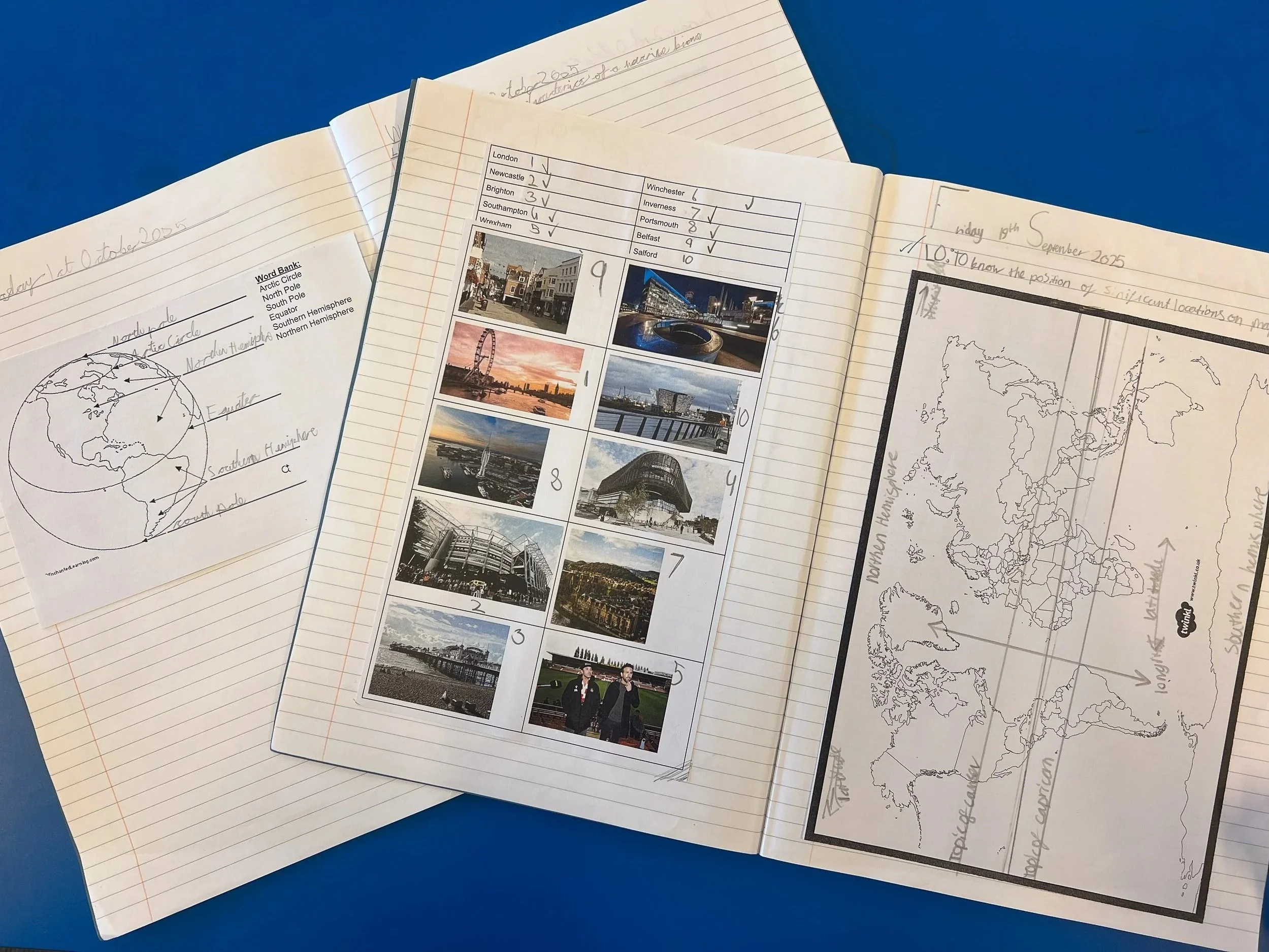
Mapping activities
Data collection and interpretation
Use of atlases and globes
Digital mapping technologies
Geographical enquiry
Across all year groups, teachers explicitly teach geographical vocabulary and revisit key concepts to ensure knowledge is retained and connected.
Learning is enriched through:
Educational visits and fieldwork opportunities
Local area studies
Cross-curricular links
Outdoor learning experiences
Use of high-quality maps, photographs and digital resources
Exploration of current environmental and geographical issues
Children are encouraged to ask geographical questions, investigate real-world issues and use evidence to support their conclusions, developing the disciplinary thinking of a geographer.
The impact of our geography curriculum is reflected in pupils who:
Demonstrate secure geographical knowledge and understanding.
Use geographical vocabulary accurately and confidently.
Apply geographical skills effectively across different contexts.
Interpret a range of geographical sources including maps, photographs, data and fieldwork evidence.
Understand how physical and human processes shape places and environments.
Show curiosity about the world and its people.
Recognise their responsibilities as citizens in an interconnected world.
Appreciate cultural diversity and challenge stereotypes.
Develop informed views about environmental sustainability and global issues.
By the end of Year 6, our pupils are confident geographers who can think critically, communicate effectively and make meaningful connections between people, places and environments. They leave Shamblehurst prepared for the next stage of their education with a strong sense of place, an understanding of the wider world and the knowledge needed to contribute positively to society.
Staff have carefully woven retrieval opportunities through our geography curriculum, as well as designing end of unit assessments and end of year assessments. This information is shared with their new teacher and through reports to parents. Where there are gaps in learning, teachers will ensure key knowledge and skills are retaught.
Our geography curriculum is fully aligned with the National Curriculum for England and ensures progression in:
Locational Knowledge
Place Knowledge
Human and Physical Geography
Geographical Skills and Fieldwork
Through these areas, children gain the substantive knowledge, disciplinary understanding and cultural awareness needed to thrive in an increasingly connected world.